
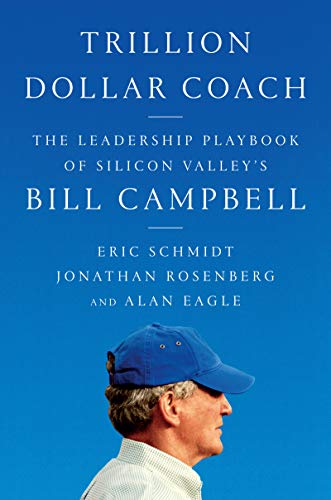
Trillion Dollar Coach
by Eric Schmidt, Jonathan Rosenberg, Alan Eagle
Finished, rated 5/5.
highlights
70 highlights saved, filed under leadership.
- 01
SOLVE THE BIGGEST PROBLEM IDENTIFY THE BIGGEST PROBLEM, THE “ELEPHANT IN THE ROOM,” BRING IT FRONT AND CENTER, AND TACKLE IT FIRST.
- 02
“learning forward.” Not what happened and who’s to blame, but what are we going to do about it?
- 03
DON’T LET THE BITCH SESSIONS LAST AIR ALL THE NEGATIVE ISSUES, BUT DON’T DWELL ON THEM. MOVE ON AS FAST AS POSSIBLE.
- 04
WINNING RIGHT STRIVE TO WIN, BUT ALWAYS WIN RIGHT, WITH COMMITMENT, TEAMWORK, AND INTEGRITY.
- 05
Leaders lead, he told him. You can’t afford to doubt. You need to commit. You can make mistakes, but you can’t have one foot in and one foot out, because if you aren’t fully committed then the people around you won’t be, either. If you’re in, be in.
- 06
LEADERS LEAD WHEN THINGS ARE GOING BAD, TEAMS ARE LOOKING FOR EVEN MORE LOYALTY, COMMITMENT, AND DECISIVENESS FROM THEIR LEADERS.
- 07
FILL THE GAPS BETWEEN PEOPLE LISTEN, OBSERVE, AND FILL THE COMMUNICATION AND UNDERSTANDING GAPS BETWEEN PEOPLE.
- 08
PERMISSION TO BE EMPATHETIC LEADING TEAMS BECOMES A LOT MORE JOYFUL, AND THE TEAMS MORE EFFECTIVE, WHEN YOU KNOW AND CARE ABOUT THE PEOPLE.
- 09
“Bill showed me that when you have a friend who is injured or ill or needs you in some way, you drop everything and just go. That’s what you do, that’s how you really show up. That’s what Bill would do. Just go.”
- 10
“That’s one of the biggest things I learned from Bill. Don’t just sit your butt in the seat. Get up and support the teams, show the love for the work they are doing.”
- 11
We learned from Bill that it’s okay to help people. Do favors. Apply judgment in making sure that they are the right thing to do, and ensure that everyone will be better off as a result. Then do the favor.
- 12
PAIR PEOPLE PEER RELATIONSHIPS ARE CRITICAL AND OFTEN OVERLOOKED, SO SEEK OPPORTUNITIES TO PAIR PEOPLE UP ON PROJECTS OR DECISIONS.
- 13
Bill’s guiding principle was that the team is paramount, and the most important thing he looked for and expected in people was a “team-first” attitude.
- 14
“You always had the sense he was building a team,” says Sheryl Sandberg. “With Bill, it wasn’t executive coaching or career coaching. It was never just about me. It was always about the team.”
- 15
As managers, we tend to focus on the problem at hand. What is the situation? What are the issues? What are the options? And so on. These are valid questions, but the coach’s instinct is to lead with a more fundamental one. Who was working on the problem? Was the right team in place? Did they have what they needed to succeed? “When I became CEO of Google,” Sundar Pichai says, “Bill advised me that at that level, more than ever before, you need to bet on people. Choose your team. Think much harder about that.”
- 16
WORK THE TEAM, THEN THE PROBLEM WHEN FACED WITH A PROBLEM OR OPPORTUNITY, THE FIRST STEP IS TO ENSURE THE RIGHT TEAM IS IN PLACE AND WORKING ON IT.
- 17
“If you’re running a company, you have to surround yourself with really, really good people,” Bill said.
- 18
Bill looked for four characteristics in people. The person has to be smart, not necessarily academically but more from the standpoint of being able to get up to speed quickly in different areas and then make connections. Bill called this the ability to make “far analogies.” The person has to work hard, and has to have high integrity. Finally, the person should have that hard-to-define characteristic: grit. The ability to get knocked down and have the passion and perseverance to get up and go at it again.
- 19
“I learned an incredibly important lesson,” she says. “It’s not what you used to do, it’s not what you think, it’s what you do every day.” This is perhaps the most important characteristic Bill looked for in his players: people who show up, work hard, and have an impact every day. Doers.
- 20
PICK THE RIGHT PLAYERS THE TOP CHARACTERISTICS TO LOOK FOR ARE SMARTS AND HEARTS: THE ABILITY TO LEARN FAST, A WILLINGNESS TO WORK HARD, INTEGRITY, GRIT, EMPATHY, AND A TEAM-FIRST ATTITUDE.
- 21
MANAGE THE ABERRANT GENIUS ABERRANT GENIUSES—HIGH-PERFORMING BUT DIFFICULT TEAM MEMBERS—SHOULD BE TOLERATED AND EVEN PROTECTED, AS LONG AS THEIR BEHAVIOR ISN’T UNETHICAL OR ABUSIVE AND THEIR VALUE OUTWEIGHS THE TOLL THEIR BEHAVIOR TAKES ON MANAGEMENT, COLLEAGUES, AND TEAMS.
- 22
MONEY’S NOT ABOUT MONEY COMPENSATING PEOPLE WELL DEMONSTRATES LOVE AND RESPECT AND TIES THEM STRONGLY TO THE GOALS OF THE COMPANY.
- 23
As Bill often commented, “Why is marketing losing its clout? Because it forgot its first name: product.”
- 24
Bill liked to tell a story about when he was at Intuit and they started getting into banking products. They hired some product managers with banking experience. One day, Bill was at a meeting with one of those product managers, who presented his engineers with a list of features he wanted them to build. Bill told the poor product manager, if you ever tell an engineer at Intuit which features you want, I’m going to throw you out on the street. You tell them what problem the consumer has. You give them context on who the consumer is. Then let them figure out the features. They will provide you with a far better solution than you’ll ever get by telling them what to build.
- 25
INNOVATION IS WHERE THE CRAZY PEOPLE HAVE STATURE THE PURPOSE OF A COMPANY IS TO BRING A PRODUCT VISION TO LIFE. ALL THE OTHER COMPONENTS ARE IN SERVICE TO PRODUCT.
- 26
Bill would tell us, “When you fire someone, you feel terrible for about a day, then you say to yourself that you should have done it sooner. No one ever succeeds at their third chance.” If you’ve ever had the crappy task of firing someone, and you think back on that experience, you will realize that this is absolutely correct. But again, you must let people leave with their heads held high.
- 27
As Bill once told Ben Horowitz about a departing executive: “Ben, you cannot let him keep his job, but you absolutely can let him keep his respect.”
- 28
HEADS HELD HIGH IF YOU HAVE TO LET PEOPLE GO, BE GENEROUS, TREAT THEM WELL, AND CELEBRATE THEIR ACCOMPLISHMENTS.
- 29
He was also quite clear about what a bad board member looks like: “Someone who just walks in and wants to be the smartest guy in the room and talks too much.”
- 30
BILL ON BOARDS IT’S THE CEO’S JOB TO MANAGE BOARDS, NOT THE OTHER WAY AROUND.
- 31
Trust means you keep your word. If you told Bill you were going to do something, you did it. And the same applied to him; his word was always good.
- 32
Team psychological safety, according to a 1999 Cornell study, is a “shared belief held by members of a team that the team is safe for interpersonal risk taking . . . a team climate . . . in which people are comfortable being themselves.”
- 33
“But I don’t care about any of that,” Bill said. “I only have one question: Are you coachable?”
- 34
Leadership is not about you, it’s about service to something bigger: the company, the team. Bill believed that good leaders grow over time, that leadership accrues to them from their teams. He thought people who were curious and wanted to learn new things were best suited for this. There was no room in this formula for smart alecks and their hubris.
- 35
“A coach is someone who tells you what you don’t want to hear, who has you see what you don’t want to see, so you can be who you have always known you could be.”
- 36
The traits of coachability Bill sought were honesty and humility, the willingness to persevere and work hard, and a constant openness to learning.
- 37
Hennessy says, “People who generate a lot of BS aren’t coachable. They start to believe what they are saying. They shade the truth to conform to their BS, which makes the BS even more dangerous.”
- 38
ONLY COACH THE COACHABLE THE TRAITS THAT MAKE A PERSON COACHABLE INCLUDE HONESTY AND HUMILITY, THE WILLINGNESS TO PERSEVERE AND WORK HARD, AND A CONSTANT OPENNESS TO LEARNING.
- 39
Al Gore says he learned from Bill how “important it is to pay careful attention to the person you are dealing with . . . give them your full, undivided attention, really listening carefully. Only then do you go into the issue. There’s an order to it.”
- 40
Bill was following the advice of the great UCLA basketball coach John Wooden, who felt that poor listening was a trait shared by many leaders: “We’d all be a lot wiser if we listened more,” Wooden said, “not just hearing the words, but listening and not thinking about what we’re going to say.”7
- 41
A 2016 Harvard Business Review article notes that this approach of asking questions is essential to being a great listener: “People perceive the best listeners to be those who periodically ask questions that promote discovery and insight.”8
- 42
“Bill would never tell me what to do,” says Ben Horowitz. “Instead he’d ask more and more questions, to get to what the real issue was.” Ben found an important lesson in Bill’s technique that he applies today when working with his fund’s CEOs. Often, when people ask for advice, all they are really asking for is approval. “CEOs always feel like they need to know the answer,” Ben says. “So when they ask me for advice, I’m always getting a prepared question. I never answer those.” Instead, like Bill, he asks more questions, trying to understand the multiple facets of a situation. This helps him get past the prepared question (and answer) and discover the heart of an issue.
- 43
PRACTICE FREE-FORM LISTENING LISTEN TO PEOPLE WITH YOUR FULL AND UNDIVIDED ATTENTION—DON’T THINK AHEAD TO WHAT YOU’RE GOING TO SAY NEXT—AND ASK QUESTIONS TO GET TO THE REAL ISSUE.
- 44
An important component of providing candid feedback is not to wait. “A coach coaches in the moment,” Scott Cook says. “It’s more real and more authentic, but so many leaders shy away from that.” Many managers wait until performance reviews to provide feedback, which is often too little, too late.
- 45
NO GAP BETWEEN STATEMENTS AND FACT BE RELENTLESSLY HONEST AND CANDID, COUPLE NEGATIVE FEEDBACK WITH CARING, GIVE FEEDBACK AS SOON AS POSSIBLE, AND IF THE FEEDBACK IS NEGATIVE, DELIVER IT PRIVATELY.
- 46
DON’T STICK IT IN THEIR EAR DON’T TELL PEOPLE WHAT TO DO; OFFER STORIES AND HELP GUIDE THEM TO THE BEST DECISIONS FOR THEM.
- 47
Millard “Mickey” Drexler, the former CEO of J.Crew and Gap, who sat on the Apple board for sixteen years alongside Bill, is a firm believer in the CEO as coach model, particularly in challenging times. When things are bad, “people come into work every day getting beat up. Everyone feels awful. As a leader, you can’t fix problems on your own, and you can’t fix them when morale is down. So you need to build the confidence of the team.”
- 48
BE THE EVANGELIST FOR COURAGE BELIEVE IN PEOPLE MORE THAN THEY BELIEVE IN THEMSELVES, AND PUSH THEM TO BE MORE COURAGEOUS.
- 49
FULL IDENTITY FRONT AND CENTER PEOPLE ARE MOST EFFECTIVE WHEN THEY CAN BE COMPLETELY THEMSELVES AND BRING THEIR FULL IDENTITY TO WORK.
- 50
start treating teams, not individuals, as the fundamental building block of the organization.
- 51
The five key factors could have been taken right out of Bill Campbell’s playbook. Excellent teams at Google had psychological safety (people knew that if they took risks, their manager would have their back). The teams had clear goals, each role was meaningful, and members were reliable and confident that the team’s mission would make a difference. You’ll see that Bill was a master at establishing those conditions: he went to extraordinary lengths to build safety, clarity, meaning, dependability, and impact into each team he coached.
- 52
There is another, equally critical, factor for success in companies: teams that act as communities, integrating interests and putting aside differences to be individually and collectively obsessed with what’s good for the company.
- 53
To Bill, being an executive of a successful company is all about management, about creating operational excellence. As a manager and CEO, Bill was very good at making sure his teams delivered. He brought people together and created a strong team culture, but never lost sight of the fact that results mattered, and that they were a direct result of good management. “You have to think about how you’re going to run a meeting,” he told a group of Googlers in a management seminar. “How you’re going to run an operations review. You’ve got to be able to look at someone in a one-on-one and know how to help them course correct. People who are successful run their companies well. They have good processes, they make sure their people are accountable, they know how to hire great people, how to evaluate them and give them feedback, and they pay them well.”
- 54
Or, as Bill liked to say: “If you’re a great manager, your people will make you a leader. They acclaim that, not you.”
- 55
“Bill, your title makes you a manager; your people make you a leader.”*
- 56
IT’S THE PEOPLE People are the foundation of any company’s success. The primary job of each manager is to help people be more effective in their job and to grow and develop. We have great people who want to do well, are capable of doing great things, and come to work fired up to do them. Great people flourish in an environment that liberates and amplifies that energy. Managers create this environment through support, respect, and trust. Support means giving people the tools, information, training, and coaching they need to succeed. It means continuous effort to develop people’s skills. Great managers help people excel and grow. Respect means understanding people’s unique career goals and being sensitive to their life choices. It means helping people achieve these career goals in a way that’s consistent with the needs of the company. Trust means freeing people to do their jobs and to make decisions. It means knowing people want to do well and believing that they will.
- 57
START WITH TRIP REPORTS TO BUILD RAPPORT AND BETTER RELATIONSHIPS AMONG TEAM MEMBERS, START TEAM MEETINGS WITH TRIP REPORTS, OR OTHER TYPES OF MORE PERSONAL, NON-BUSINESS TOPICS.
- 58
“Think that everyone who works for you is like your kids,” Bill once said. “Help them course correct, make them better.”
- 59
“Back then, I was ninety percent style, ten percent substance,” Nirav remembers. “Bill was one hundred percent substance.”
- 60
5 WORDS ON A WHITEBOARD HAVE A STRUCTURE FOR 1:1s, AND TAKE THE TIME TO PREPARE FOR THEM, AS THEY ARE THE BEST WAY TO HELP PEOPLE BE MORE EFFECTIVE AND TO GROW.
- 61
BILL’S FRAMEWORK FOR 1:1s AND REVIEWS PERFORMANCE ON JOB REQUIREMENTS Could be sales figures Could be product delivery or product milestones Could be customer feedback or product quality Could be budget numbers RELATIONSHIP WITH PEER GROUPS (This is critical for company integration and cohesiveness) Product and Engineering Marketing and Product Sales and Engineering MANAGEMENT/LEADERSHIP Are you guiding/coaching your people? Are you weeding out the bad ones? Are you working hard at hiring? Are you able to get your people to do heroic things? INNOVATION (BEST PRACTICES) Are you constantly moving ahead . . . thinking about how to continually get better? Are you constantly evaluating new technologies, new products, new practices? Do you measure yourself against the best in the industry/world?
- 62
Bill believed that one of a manager’s main jobs is to facilitate decisions, and he had a particular framework for doing so. He didn’t encourage democracy. (Before he arrived at Intuit, they took votes in meetings. Bill stopped that practice.)
- 63
As Emil Michael, a Bill coachee and former CBO of Uber, says, “When a leader can get people past being passive-aggressive, then heated but honest arguments can happen.”
- 64
Bill gave her a new rule: when she was discussing a decision with her team, she always had to be the last person to speak. You may know the answer and you may be right, he said, but when you just blurt it out, you have robbed the team of the chance to come together. Getting to the right answer is important, but having the whole team get there is just as important.
- 65
When the best idea doesn’t emerge, it’s time for the manager to force the decision or make it herself. “A manager’s job is to break ties and make their people better,” Bill said. “We’re going to do it this way. Cut the shit. Done.”
- 66
Failure to make a decision can be as damaging as a wrong decision. There’s indecision in business all the time, because there’s no perfect answer. Do something, even if it’s wrong, Bill counseled.
- 67
This is consistent with the King Arthur round-table model of decision making that Bill described to Brad Smith when Brad became CEO of Intuit. (As Brad tells us this story, he points out the model of the legendary table, with a full complement of seated knights, that sits in the corner of his office.) If you have the right conversation, Bill counseled, then eight out of ten times people will reach the best conclusion on their own. But the other two times you need to make the hard decision and expect that everyone will rally around it. There isn’t a head of that table, but there is a throne behind it.
- 68
THE THRONE BEHIND THE ROUND TABLE THE MANAGER’S JOB IS TO RUN A DECISION-MAKING PROCESS THAT ENSURES ALL PERSPECTIVES GET HEARD AND CONSIDERED, AND, IF NECESSARY, TO BREAK TIES AND MAKE THE DECISION.
- 69
LEAD BASED ON FIRST PRINCIPLES DEFINE THE “FIRST PRINCIPLES” FOR THE SITUATION, THE IMMUTABLE TRUTHS THAT ARE THE FOUNDATION FOR THE COMPANY OR PRODUCT, AND HELP GUIDE THE DECISION FROM THOSE PRINCIPLES.
- 70
He called them “aberrant geniuses,” and said, “You get these quirky guys or women who are going to be great differentiators for you. It is your job to manage that person in a way that doesn’t disrupt the company. They have to be able to work with other people. If they can’t, you need to let them go. They need to work in an environment where they collaborate with other people.”