
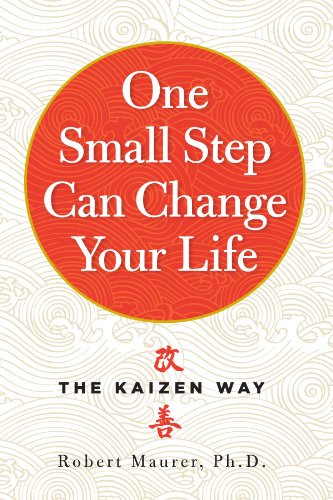
One Small Step Can Change Your Life
by Robert Maurer
Finished, rated 5/5.
highlights
42 highlights saved, filed under productivity.
- 01
We are so accustomed to living with minor annoyances that it’s not always easy to identify them, let alone make corrections. But these annoyances have a way of acquiring mass and eventually blocking your path to change. By training yourself to spot and solve small problems, you can avoid undergoing much more painful remedies later.
- 02
how many times have we, in our haste to reach a goal, spotted signs of trouble—and then recategorized them as “normal,” just to avoid facing them?
- 03
Hindsight, as they say, is 20/20, and it’s always easier to spot a crack in the ceiling after rain has soaked the plaster.
- 04
“Confront the difficult while it is still easy; accomplish the great task by a series of small acts.” —Tao Te Ching
- 05
“broken windows” theory, first postulated in 1982 by two criminologists, James Q. Wilson and George L. Kelling. The broken windows theory held that if a city—or a neighborhood or a street—tolerated minor infractions of the law, it was practically inviting more serious offenses.
- 06
Whether you wish to train yourself or others to instill better habits, small rewards are the perfect encouragement. Not only are they inexpensive and convenient, but they also stimulate the internal motivation required for lasting change.
- 07
The kaizen approach to life requires a slower pace and an appreciation of small moments. This pleasant technique can lead to creative breakthroughs and strengthened relationships, and give you a daily boost toward excellence.
- 08
“To be really great in little things, to be truly noble and heroic in the insipid details of everyday life, is a virtue so rare as to be worthy of canonization.” —Harriet Beecher Stowe
- 09
“Do your little bit of good where you are; it’s those little bits of good put together that overwhelm the world.” —Desmond Tutu
- 10
“Turning toward your spouse in the little ways is also the key to long-lasting romance. Many people think that the secret to reconnecting with their partner is a candlelight dinner or a by-the-sea vacation. But the real secret is to turn toward each other in little ways every day.” —John Gottman
- 11
Ask yourself: Do I need to learn to change anything based on this worry or regret of mine?
- 12
“Small things with great love. . . . It is not how much we do, but how much love we put into the doing. And it is not how much we give, but how much love we put into the giving. To God there is nothing small.” —Mother Teresa
- 13
Kaizen is an ancient philosophy captured in this powerful statement from the Tao Te Ching: “The journey of a thousand miles begins with a single step.” Though it is rooted in ancient philosophy, it is just as practical and effective when applied to our hectic modern lives. Kaizen has two definitions: using very small steps to improve a habit, a process, or product using very small moments to inspire new products and inventions
- 14
As John Wooden, the legendary UCLA basketball coach, expressed it, “You can’t live a perfect day without doing something for someone who will never be able to repay you.”
- 15
“Life’s most persistent and urgent question is: What are you doing for others?” —Martin Luther King Jr.
- 16
“Let no one ever come to you without leaving better and happier.” —Mother Teresa
- 17
“I long to accomplish a great and noble task but it is my chief duty to accomplish small tasks as if they were great and noble.” —Helen Keller
- 18
“I would rather have it said, ‘He lived usefully’ than ‘He died rich.’ ” —Benjamin Franklin
- 19
“A journey of a thousand miles must begin with the first step.” —Lao Tzu
- 20
“When you improve a little each day, eventually big things occur. When you improve conditioning a little each day, eventually you have a big improvement in conditioning. Not tomorrow, not the next day, but eventually a big gain is made. Don’t look for the big, quick improvement. Seek the small improvement one day at a time. That’s the only way it happens—and when it happens, it lasts.” —John Wooden, one of the most successful coaches in the history of college basketball
- 21
Kaizen Versus Innovation Kaizen and innovation are the two major strategies people use to create change. Where innovation demands shocking and radical reform, all kaizen asks is that you take small, comfortable steps toward improvement.
- 22
A frustrated manager might actually try giving smaller, not larger, rewards to employees to increase their motivation.
- 23
low-key change helps the human mind circumnavigate the fear that blocks success and creativity.
- 24
asking small questions to dispel fear and inspire creativity thinking small thoughts to develop new skills and habits—without moving a muscle taking small actions that guarantee success solving small problems, even when you’re faced with an overwhelming crisis bestowing small rewards to yourself or others to produce the best results recognizing the small but crucial moments that everyone else ignores
- 25
large goal ➞ fear ➞ access to cortex restricted ➞ failure small goal ➞ fear bypassed ➞ cortex engaged ➞ success
- 26
Jack Welch, the past CEO of General Electric: “Everyone who is running something goes home at night and wrestles with the same fear: Am I going to be the one who blows this place up?”
- 27
When life gets scary and difficult, we tend to look for solutions in places where it is easy or at least familiar to do so, and not in the dark, uncomfortable places where real solutions might lie.
- 28
“Courage is resistance to fear, mastery of fear, not absence of fear.” —Mark Twain
- 29
Small questions create a mental environment that welcomes unabashed creativity and playfulness. When you ask small questions of others, you channel that creative force toward team goals. By asking small questions of yourself, you lay the groundwork for a personalized program for change.
- 30
“What shapes our lives are the questions we ask, refuse to ask, or never think to ask.” —Sam Keen
- 31
The hippocampus’s main criterion for storage is repetition, so asking that question over and over gives the brain no choice but to pay attention and begin to create answers.
- 32
Your brain loves questions and won’t reject them . . . unless the question is so big it triggers fear.
- 33
By asking small, gentle questions, we keep the fight-or-flight response in the “off” position. Kaizen questions such as “What’s the smallest step I can take to be more efficient?” or
- 34
If I were guaranteed not to fail, what would I be doing differently?
- 35
What is one small step I could take toward reaching my goal?
- 36
What is one small step I could take to improve my health (or relationships, or career, or any other area)?
- 37
Is there a person at work or in my personal life whose voice and input I haven’t heard in a long time? What small question could I ask this person?
- 38
What’s one good thing about this person?
- 39
What is one small thing that is special about me (or my spouse, or my organization)?
- 40
The easy technique of mind sculpture uses “small thoughts” to help you develop new social, mental, and even physical skills—just by imagining yourself performing them!
- 41
Mind sculpture, developed by Ian Robertson, is a newer technique that involves total but still-imaginary sensory immersion. It requires its practitioners to pretend that they are actually engaged in the action, not just seeing but hearing, tasting, smelling, and touching. In mind sculpture, people imagine the movement of their muscles, and the rise and fall of their emotions.
- 42
Isn’t slow change better than what I’ve experienced before . . . which is no change at all?